

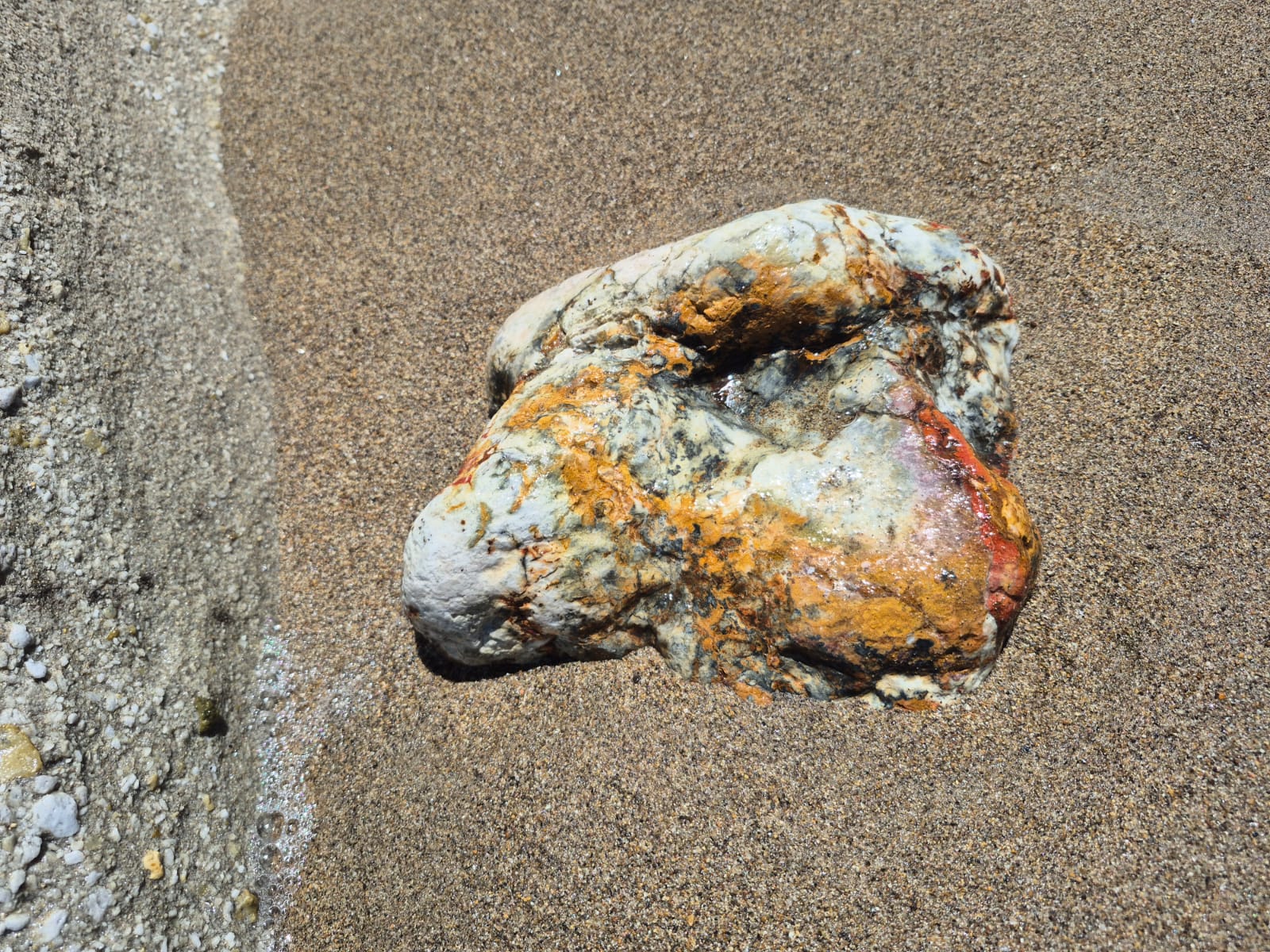
Sea - Sand - Stone
Every child can do Reiki. So can every elderly person. It is a particular joy and honour to be allowed to attune people with physical or intellectual disabilities to reiki. The beautiful thing about Reiki practice is its simplicity!
This is more or less how I like to put it in my public lectures. For 34 years now. I also like to use it as an introduction at professional conferences. Coupled with the statement that the important thing about Reiki is self-treatment.
(I use reiki below when I mean the energetic phenomenon, and Reiki when I am referring to the practice, teaching or history.)
For the layperson, the simplicity of Reiki is a strong argument for giving it a chance and trying it out. No religious or other beliefs are necessary, no concentration, no particular mindset. Unlike conventional energy practices, reiki does not weaken the person applying it, but actually strengthens them. There are no dogmas or commandments in Reiki. Indeed, the opposite is true in this respect too: the practice helps us free ourselves from harmful patterns.
“Child’s play!”
Even Hawayo Takata (1900–1980), the key figure in the global development of Reiki, said: “Reiki is child’s play.” It is useful if you can count to four. (There are four hand positions each on the head, the front of the torso and the back of the torso – see Body Positions.)
The rationale
Unfortunately – or fortunately – reiki cannot be described as energy in the conventional physical sense, because it cannot be controlled and eludes the prevailing definitions of energy. In practice, this means what all practitioners have already experienced: reiki can be applied without our diagnosis or analysis. It seems to possess an intelligence of its own and can neither be manipulated nor controlled. This independence liberates us completely and relegates us to a supporting role in which we are literally no more than the handmaid.
Hands on, and that’s it.
In physics, particularly quantum physics, such ‘non-polarised’ phenomena are known. Modern physics, and quantum physics in particular, has fundamentally changed our picture of a world that can be clearly determined. Concepts such as uncertainty (particle or wave?) remind us that reality is not always as clearly describable as we would like it to be.
References like these, expressed in scientific jargon, sound anything but simple. Perhaps. But it is precisely this characteristic that can be observed in Reiki practice and that helps us understand why the energetic phenomenon we work with – reiki – is not ‘ordinary’ energy.
Or, put more simply: Usui named the phenomenon he discovered Rei and Ki because in practice he experienced the unpredictability or ‘own intelligence’ of reiki. This is why the name Reiki can also be read in this way: Rei before Ki – as an indication that what we are working with is not simply an ordinary form of Ki. Ki (Chinese: Qi) encompasses a broad spectrum of concepts that in the West are often subsumed under the term energy. Rei points towards something that reaches beyond the ordinary understanding of Ki in a polarised world.
The problem
We all know how difficult it is to explain how our practice works. Precisely because reiki operates beyond our influence (independently ‘knowing’ where it needs to act, where the original as well as the symptomatic imbalances are located within the being) and requires neither diagnosis nor analysis – in other words, precisely all the things that make it so simple and accessible – it stands in stark contrast to the prevailing spirit of our age, which celebrates everything that can be predicted and controlled.
The dictate of the rational stands diametrically opposed to the mercurial quality of reiki.
Either/or?
For some Reiki practitioners, their own desire for understanding, together with the prevailing urge to know and comprehend, is so dominant that they constantly seek out more information. At present, for example, an author writing under a pseudonym (Mamoru Wakatake) is enormously popular on Facebook, discussing increasingly varied and detailed historical information. The man draws on the original knowledge of the Usui Reiki Ryoho Gakkai, the organisation founded by Mikao Usui just over 100 years ago. In my role as a Reiki teacher (not as a practitioner!), I follow his posts in order to keep up to date. They often remind me of the well-known saying: a specialist is someone who concentrates on knowing more and more about less and less, until eventually he knows everything about nothing.
Interestingly, if one so wishes, the revelations of the Gakkai whistleblower can be seen to confirm modern Reiki practice as it is represented in Western Reiki through Hawayo Takata and, in particular, Usui Shiki Ryoho. For example, the simple statement made at the beginning of this article in Western Reiki, “Hands on!”, which so aptly illustrates the practice through touch, appears again when the Japanese author speaks of “Teate Ryoho” (traditional laying on of hands). And this brings us to the title of this article.
Both!
The challenge of simplicity must already have existed in Usui’s very first experiences a hundred years ago. Quantum physics, which was just beginning with Einstein, Bohr and Planck and which today gives us some theoretical room for explanation, is unlikely to have been an issue for him. The focus was on practice. Moreover, in Japan at the time there were religious and philosophical traditions in which concepts that may appear inexplicable to us today had an entirely legitimate place. Yet the tension between the concept of Ki and the particular qualities of reiki must already have been apparent at that time. Seen in this light, simplicity in Reiki practice is nothing new. At the same time, it presents us today with challenges that are more unconventional and progressive than ever.
“Intelligence is the ability to hold two opposing ideas in mind at the same time and still retain the ability to function.”
Anachronism or avant-garde? Both! What may have been self-evident a hundred years ago appears revolutionary today: the willingness to practise something without having to control, explain or even understand it. Simple. Reiki.
René Vögtli

Sikinos, August 2026
NB
- In this article, I use reiki when I mean the energetic phenomenon, and Reiki when I am referring to the practice, teaching or history.
- The final quotation is attributed to the American author F. Scott Fitzgerald (1896–1940).
- This article was originally written in German and translated with the aid of AI – and counterchecked by the author.