


Why less welcome treatment outcomes deserve a place, too.
We like talking about our successes with Reiki. Here a baby’s kidney failure resolved, there a marriage saved, elsewhere someone overcoming burnout. But what happens when Reiki does not help?
A prospective Reiki teacher asked me something along these lines recently: “What about failures with Reiki? We like to put our successes centre stage. Isn’t that one-sided, and doesn’t it distort the picture?”
An inner voice immediately reacted: “That’s not true at all! I never promise success. On the contrary, I explicitly point out that we can neither give nor are we permitted to give any guarantee of healing. I repeatedly emphasise that Reiki is not a remedy in itself and that healing may well require invasive medical interventions. Quite often, I put myself in the firing line in alternative medicine circles by publicly speaking up in support of conventional medicine and the pharmaceutical industry. I ask the provocative question: How many of us would be here today if it weren’t for antibiotics and life-saving medical care?”
Yes, that may essentially be correct, and even legally. But is it the whole picture?
A look back: Reiki a hundred years ago
The ‘apprentice’s’ question made me more aware of the subject, and I came across an interesting Facebook post by Mamoru Wakatake. (This is a pseudonym; I have a direct connection with the Japanese author.) In it, he writes about Kaiji Tomita, a Japanese Reiki practitioner who learned Reiki in the 1920s and published a book in 1933 about the treatment practices of the time.
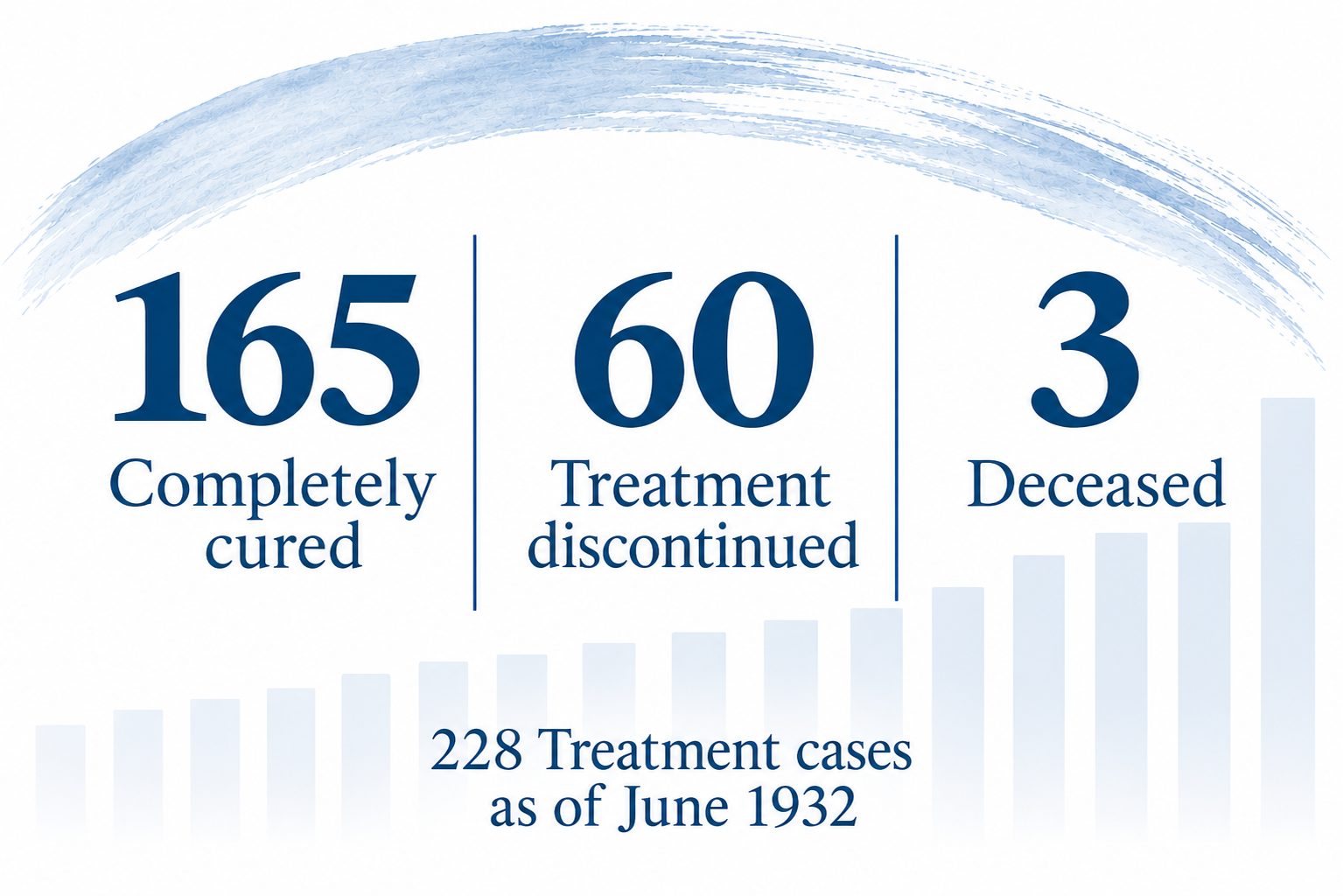
Of particular note is a table showing the treatment outcomes recorded by his association. Tomita was concerned that reports tended to focus mainly on people who had recovered. He wanted to give the public a more complete picture and therefore also published the other treatment outcomes.
Experiences Then and Now
By June 1932, 228 people had come for treatment. Tomita recorded 165 as ‘fully recovered’, 60 had discontinued treatment and three had died. These are statistics we should take note of today, too. Although I have never kept records, I feel that this distribution is reflected, at least broadly, in Mischa’s and my own experience.
Anyone who reports only successes is not telling the whole story.
The table also broke down the results by illness. For example, of 16 people with stomach or intestinal conditions, twelve were recorded as fully recovered, while four discontinued treatment. Among eight people with lung diseases, by contrast, three were recorded as recovered and five discontinued treatment. (This observation cannot simply be transferred to the present day without comment, since tuberculosis was widespread at the time.) The overall picture of 165 recoveries among 228 people treated therefore conceals differences between individual illnesses.
One further qualification is important: discontinuing treatment does not necessarily mean that the treatment was unsuccessful. As Tomita himself explained, some people had stopped after just one or a few sessions, before it was even possible to assess how their condition might develop. He therefore explicitly distinguished between those who had recovered, those who had discontinued treatment and those who had died.
What can we learn from this?
What impresses me about Tomita is less the number of recoveries he recorded than his willingness to disclose outcomes that were less welcome. He could probably quite easily have restricted his report to the 165 successes.
Wakatake draws the following conclusion: even today, we should not record only those occasions when people are satisfied and their hopes are fulfilled. We should also address situations in which no changes occur or someone does not continue with treatment. What had the person concerned hoped for? And to what extent are we ourselves responsible for the expectations they may have formed?
From the perspective of my modern Reiki practice, I understand that Reiki cannot be measured solely by changes at the level of symptoms. Even when the desired result does not materialise there, Reiki works on other, deeper levels. Our holistic approach today, and the way we communicate this perspective, help ensure that practitioners do not create an illusory picture for either themselves or their clients. Nevertheless — and this is the message of this article — the uncomfortable aspects, too, may and should be reflected upon and openly acknowledged.
This may be uncomfortable, because naturally we prefer to remember positive experiences. But if we fail to address apparent failures as well, we not only end up with an incomplete picture; we also miss an opportunity to question our own work and learn from it, so that it may serve the people who place their trust in us more fully.
Completing the Picture
I would like to return once more to the prospective Reiki teacher’s question. Of course, we should and may rejoice in our successes! To conceal or downplay them would be equally dishonest. The process itself, and how we communicate our successes, are nevertheless matters that deserve a discussion of their own.
Tomita gave us a remarkable example, almost a hundred years ago, of how to convey as comprehensive a picture as possible of treatment practice. For me, his openness about the different treatment outcomes expresses an attitude that remains valid today.
A grateful Namaste to the old master Kaiji Tomita, to Mamoru Wakatake and to the ‘apprentice’ who asked the question.
Love.

René Vögtli
NB
-
This article comes in the wake of reikis-simplicity-anachronism-or-avant-garde/ and value-of-negative-affirmations-the-story-of-hunna/.
-
Our archive casestudies/ speaks predominantly of ‘successes’ — but not exclusively.
-
The research collection at the WRR Competence Centre is, in a sense, a continuation of Kaiji Tomita’s work from a hundred years ago.
The original of this article is in German – I have used ChatGPT to help me translate.